 Binod Sahayatri
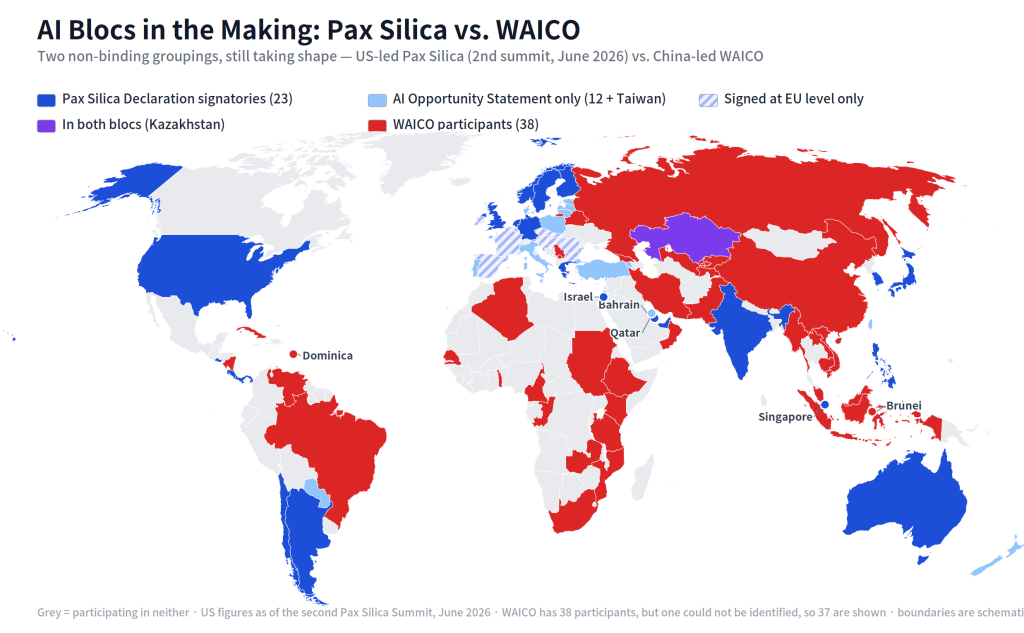
In December 2025 the United States launched Pax Silica, a non-binding, invitation-based framework for securing the supply chains that underpin artificial intelligence (AI). In July 2026, China and 28 other states signed the treaty founding the World Artificial Intelligence Cooperation Organization (WAICO), an open-membership body oriented toward capacity-building and governance. Commentators quickly framed the two as rival blocs. This article asks to what extent they are competing projects for shaping the digital and technological order, and whether the emerging pattern is technological bipolarity or something more complex.
Using a qualitative comparative design (process tracing, comparative institutional analysis, document analysis, six country cases and a scenario analysis of Nepal) and evidence verified to 19 September 2026, the article makes three arguments. First, the initiatives are institutionally asymmetric. Pax Silica works on material layers of the AI stack (minerals, chips, manufacturing, infrastructure). WAICO works on ideational and developmental layers (standards, training, open-source ecosystems, governance), and its founding text confines it to civilian AI. Treating them as mirror-image blocs, or as NATO analogues, overstates their institutionalisation. Second, membership clusters (advanced economies and mineral or energy partners in Pax Silica; Global South and BRICS-adjacent states in WAICO), but overlap is real, and national procurement splits layers of the stack across ecosystems. Third, the strongest bipolarising mechanism, a U.S. exclusivity requirement reported in a draft letter, had not been confirmed as issued or enforced on the evidence available.
The article proposes technological structural power as an extension of Susan Strange’s framework and digital geopolitical conflict as an analytical category. It concludes that the evidence better supports competitive interdependence with bipolar signalling than a consolidated bipolar order, and it draws implications for small states, including Nepal.
Keywords: Pax Silica; WAICO; AI geopolitics; technological structural power; weaponized interdependence; strategic hedging; digital sovereignty; critical minerals; semiconductors; Global South
- Introduction
1.1 Problem and context
Control over the inputs to advanced AI (critical minerals, semiconductors, computing capacity, energy, data, models and standards) has become a matter of statecraft. Two institutional responses emerged within seven months. The U.S. Department of State launched Pax Silica on 12 December 2025 as its flagship initiative on AI and supply-chain security (U.S. Department of State, 2025). China, having proposed a World Artificial Intelligence Cooperation Organization (WAICO) in July 2025, saw 29 states sign its founding agreement in Shanghai on 16 July 2026 (Xinhua, 2026a).
Much commentary treats the two as the opening of a new bloc confrontation (see the discussion in Norton Rose Fulbright, 2026). That framing may be right, but it is an empirical claim that has to be tested. It says nothing yet about how far either body binds its members, whether states are actually being forced to choose, or whether the two bodies operate on the same layer of the technology stack at all.
1.2 Research questions and hypotheses
The central question is: to what extent do Pax Silica and WAICO represent competing geopolitical projects for shaping the emerging global digital and technological order?
Sub-questions cover (RQ1) origins; (RQ2) objectives; (RQ3) institutional architecture; (RQ4) membership patterns; (RQ5) the strategic autonomy of middle powers and small states; and (RQ6) whether the pattern is best described as bipolarity, fragmentation, competitive interdependence, hedging or a layered order. Five hypotheses are tested in sesction 10:
- H1. The initiatives are producing technological bipolarity.
- H2. They are producing fragmented multipolarity.
- H3. They are producing competitive interdependence rather than decoupling.
- H4. Middle powers can prevent bipolarisation through hedging and diversification.
- H5. The result is a multi-layered digital order in which states cooperate across competing ecosystems.
1.3 Method and evidence standard
The study is a qualitative comparative case study. Process tracing reconstructs the two causal chains that led to the initiatives (Section 2). Comparative institutional analysis contrasts their design against a set of criteria (Section 5). Document analysis and discourse analysis cover official texts (the Pax Silica fact sheets and declarations, the WAICO agreement, ministerial statements, a parliamentary reply). Comparative case analysis examines six actors chosen for variation in strategic behaviour: India, Singapore, Kazakhstan, Uzbekistan, Indonesia and the European Union (Section 7). Nepal is treated as a scenario-based small-state case (Section 9).
Tier 1 is institutional analysis (think tanks, law-firm briefings). Tier 2 is journalism. Because the subject is fast-moving, most evidence after June 2026 is Tier 3, and claims that rest on a single outlet are flagged. The Evidence Matrix (Table 6) separates verified facts, official claims, expert interpretation and disputed or uncertain claims. An official claim is not treated as established fact without corroboration.
1.4 Gap and contribution
Three gaps stand out. First, the literatures on AI governance and on semiconductor and minerals geopolitics have developed largely in parallel, and the two initiatives are precisely where they meet. Second, the two initiatives have been analysed mostly separately, and scholarly comparison is thin because WAICO is only weeks old. One early preprint maps WAICO within the AI governance “regime complex” (Guey et al., 2026) and I have read only its abstract-level material. Third, the concept of weaponized interdependence (Farrell & Newman, 2019) was developed for financial and communications networks, and how it applies to AI stacks and to club-membership discipline has not been worked out.
The article contributes (a) an empirical comparison of the two initiatives, (b) the concept of technological structural power, (c) the observation of layered hedging by middle powers, and (d) a small-state analysis.
- The Rise of Technology Geopolitics, 2018–2025
2.1 Two causal chains
The record supports two partly independent trajectories that converged in mid-2026.
Chain A (United States): trade and technology rivalry → targeting of Huawei → semiconductor export controls → subsidy and industrial policy → mineral vulnerability → AI-stack securitisation → Pax Silica.
Chain B (China): experience of controls → self-reliance drive in chips → open-weight AI and AI diplomacy → Global South capacity-building offers → institutional proposal (2025) → WAICO.
Table 1 sets out the chronology. Entries from 2018 to 2024 are well-established public record that I am citing from background knowledge, and the source column marks where a primary citation (Federal Register, BIS, MOFCOM) still needs to be added. Entries from 2025 onward are tied to sources I retrieved.
2.2 What the process tracing shows
Two observations matter for the argument. First, the two chains have different logics. Chain A is about denial and diversification (reducing “coercive dependencies”), and Chain B is about access and legitimacy. Second, the mineral truce of late 2025 shows that both governments retain and use leverage even while negotiating, which is what a competitive-interdependence account would predict and a clean-decoupling account would not.
- Pax Silica
3.1 Origins and stated purpose
The State Department describes Pax Silica as a coalition built around a “secure, resilient, and innovation-driven” ecosystem across the technology supply chain, from critical minerals and energy to manufacturing, semiconductors, AI infrastructure and logistics. Its declared aims are to reduce “coercive dependencies,” protect materials and capabilities foundational to AI, and enable aligned states to deploy technology at scale. The fact sheet also calls the framework a “positive-sum partnership” that is “not about isolating others” (U.S. Department of State, 2025). The declaration does not name China, though analysts read it as aimed at Chinese non-market practices and dependencies (Foster, 2025). The name deliberately echoes Pax Americana (U.S. Department of State, 2025).
Official claim versus interpretation: “positive-sum” is the sponsor’s self-description. That the initiative seeks to route supply chains around China is an interpretation shared by analysts (e.g., Foster, 2025) and by Reuters’ reporting on U.S. officials’ aims (Martina, 2026).
3.2 Institutional form
- Legal status. The Declaration is described as non-binding (Wikipedia contributors, 2026a; Martina, 2026). I did not locate any enforcement mechanism in the public texts.
- Two instruments. As of August 2026 there were 25 signatories to the Declaration and 35 states that had signed the separate AI Opportunity Statement (Kertai, 2026). The latter commits signatories to a pro-innovation approach to AI regulation and to cooperation on AI infrastructure (U.S. Department of State, 2026b; Brownstein, 2026).
- Leadership. Coordination sits with the Under Secretary of State for Economic Affairs, Jacob Helberg (U.S. Department of State, 2026a).
- Money. The State Department announced plans to seek $250 million from Congress for a Pax Silica Fund for minerals, infrastructure and manufacturing assets (Brownstein, 2026). I found no evidence that the appropriation had been enacted.
- Benefits. According to Reuters, members have access to shared investment opportunities in AI-related projects, whereas AI Opportunity Statement signatories have symbolically endorsed a “common purpose” with the United States (Martina, 2026).
- Governance philosophy. In an interview cited by a law-firm briefing, Helberg presented the initiative as purpose-built for the AI economy and as an alternative to national “digital sovereignty” strategies that duplicate technology stacks (Brownstein, 2026).
3.3 Membership trajectory
Seven states signed in December 2025 (U.S. Department of State, 2025; Kertai, 2026). The Netherlands joined as a non-signing partner shortly after; Qatar and the UAE signed in January 2026; India on 20 February; then Sweden, Finland, the Philippines and Norway before the June summit (U.S. Department of State, 2026a, 2026c; Brownstein, 2026). Ten more signed at the June summit (Argentina, Chile, Costa Rica, El Salvador, the EU, Germany, Greece, Kazakhstan, the Netherlands, Panama), bringing the total to 24, with Taiwan endorsing the principles through a separate U.S.–Taiwan statement (U.S. Department of State, 2026b). Italy became the 25th in August (U.S. Department of State, 2026d; Kertai, 2026). Some outlets and a Singaporean parliamentary report still cite 24 (The Online Citizen, 2026), so the count depends on the date.
Membership was contested inside Europe. France reportedly objected to EU participation, and member states approved the Commission’s signature only in early June (Brownstein, 2026; Euronews, 2026). The Commission framed the signature as complementary to its tech-sovereignty agenda (European Commission, 2026), while critics saw a trade-off between autonomy and alignment (TNW, 2026).
- WAICO
4.1 Origins
China proposed WAICO in July 2025 (Wikipedia contributors, 2026b), building on its earlier AI governance initiatives and a UN-centred diplomatic line. A Chinese Foreign Ministry position, as reported, is that countries should decide their AI partnerships according to national conditions and oppose exclusive blocs (Bhattarai, 2026).
4.2 Institutional form
The agreement establishes WAICO as an independent intergovernmental organisation with international legal personality, headquartered in Shanghai (Xinhua, 2026a). From the text summaries I could access:
- Organs. A Council of all members and a Secretariat (Digital Watch Observatory, 2026). A secondary summary adds that the Council admits members, appoints the Secretary-General and creates subsidiary bodies (Wikipedia contributors, 2026b).
- Functions. Aligning AI development strategies, governance rules and technical standards; promoting interoperability; supporting open-source ecosystems; and promoting convergence with UN-framework processes (Digital Watch Observatory, 2026).
- Scope limit. Functions are limited exclusively to the civilian domain of AI (Digital Watch Observatory, 2026). This is a major difference from any alliance.
- Openness. Presented as open to any sovereign state without values tests (Guey et al., 2026; Stan, 2026).
- Deliverables. Xi pledged 5,000 AI training and seminar opportunities for developing countries over five years (Xinhua, 2026b).
- Decision rule and financing. The available evidence is insufficient to establish the voting rule, budget or contribution scale.
4.3 Membership
Twenty-nine states signed on 16 July, including Russia, Kazakhstan, Pakistan, Indonesia, Laos, Brazil, Belarus, Serbia, Cuba and Venezuela, with about 10 African and 12 Asian signatories (Stan, 2026; Xinhua, 2026a). Reported members also include Malaysia, Cambodia, Myanmar, Uzbekistan, Kyrgyzstan and Tajikistan (Norton Rose Fulbright, 2026; RFE/RL, 2026). No G7 member is among them (Norton Rose Fulbright, 2026), and India, holder of the 2026 BRICS presidency, was not listed (BRICS Council, 2026). UN Secretary-General Guterres attended the ceremony as a guest (Xinhua, 2026a), which a commentator noted gives at least an impression of UN endorsement (The Diplomat, 2026b).
A secondary source reports eight further accessions in late July, with a total of 37, and Bangladesh as an observer (Wikipedia contributors, 2026b).
- The Digital Geopolitical Conflict
6.1 Definition
I define digital geopolitical conflict as strategic competition among states in which control over, denial of, or dependence on layers of the digital-technological stack is deliberately used to alter relative power and to constrain others’ autonomy, mediated through firms, standards and institutions, and not necessarily involving territorial change or armed force.
Three properties separate it from territorial geopolitics. (1) The contested objects are infrastructural and relational (chokepoints, dependencies, standards), not primarily land or sea. (2) Firms are constitutive actors, since the relevant capabilities sit in corporate hands. (3) The main instruments are access conditions (licences, listings, procurement, membership) rather than force.
I test whether it replaces, supplements or fuses with traditional geopolitics. On the evidence here, it supplements and increasingly fuses with it at specific nodes: the same minerals sit in territories courted through diplomacy (Kazakhstan), and the semiconductor chain runs through contested geography (Taiwan, which attended the June Pax Silica summit as a non-signatory; U.S. Department of State, 2026b). It does not replace territorial competition.
6.2 The AI stack and where power sits
Figure 2. AI technological supply-chain architecture
- Critical minerals: mining
- Refining and processing
- Semiconductor materials
- Chip design and EDA software
- Lithography and fabrication
- Advanced packaging and memory
- GPUs and AI accelerators
- Data centres and electricity
- Cloud and compute access
- Foundation models
- Applications and data
- Standards and global markets
Table 4. Strengths, dependencies and vulnerabilities by layer (qualitative; evidence status given)
| Layer | U.S. and partners | China | Evidence status |
| Minerals and refining | Deposits in Australia, Philippines, Kazakhstan (prospective), Latin America; refining lags | Dominant in rare-earth refining and magnets; leverage used in 2024–25 | Directional claim supported by CSIS (2026); numbers not used here because reliable primary figures were not retrieved |
| Nickel (illustrative) | Philippines largest nickel-ore exporter | Chinese firms control about 75% of Indonesian nickel-refining capacity; Indonesia supplies over 60% of global nickel | IISS (2026) |
| Design, EDA, lithography, advanced fabrication | Concentrated in the U.S. and its partners (U.S., Netherlands, Japan, Taiwan, South Korea) | Behind at the frontier; strong in legacy chips | Miller (2022); update with 2026 primary data |
| AI accelerators | Nvidia/AMD lead on performance | Huawei Ascend scaling, mostly for inference; training reportedly still uses U.S. chips | Conflicting trade-press reports (Tom’s Hardware, 2026; TechTimes, 2026); BIS (2026) for policy; volumes unresolved |
| Data centres, energy | Capital-rich Gulf and U.S. providers | Large domestic build; exports of infrastructure bids (e.g., Egypt) | Bloomberg reports via Lo (2026) |
| Foundation models | Frontier proprietary models | Open-weight models gaining international uptake; one report puts Chinese open-weight models around 40% of token usage among surveyed U.S. firms by mid-2026 | CNBC report as summarised by Wikipedia contributors (2026b) — verify at source |
| Standards | U.S. and allied bodies | WAICO aims explicitly at standard alignment | Digital Watch Observatory (2026) |
Reading the table. The U.S. side holds the harder-to-replace chokepoints (advanced tooling, top-end accelerators), while China holds mineral-processing leverage and a competitive position in open-weight models. Each has vulnerabilities that the other’s initiative targets: Pax Silica targets the mineral-refining vulnerability, and WAICO targets the access and legitimacy gap for states outside the U.S.-aligned network. That is one reason the two are not simple mirror images.
6.3 Firms
Chip design, fabrication, tooling and cloud capacity are largely corporate assets: Nvidia and AMD (accelerators), TSMC, Samsung and SK hynix (fabrication and memory), ASML (lithography), Huawei and SMIC (China’s substitution effort), and U.S. and Chinese model developers (Miller, 2022). State power is therefore exercised through licences, Entity List designations and subsidy conditions that determine what firms can sell, as seen in the January 2026 BIS rule (BIS, 2026). Firms also lobby and hedge: reports of a large gap between approved licences and actual H200 shipments (TechTimes, 2026) and of Chinese preference for domestic chips (Tom’s Hardware, 2026) illustrate that firm and buyer decisions can blunt state design. I did not find sufficient primary evidence to analyse the individual roles of Alibaba, Tencent, Baidu, ByteDance or the frontier labs beyond these references. That is a gap for later work.
- Middle Powers and Strategic Hedging
7.1 Analytical frame
Hedging is behaviour that seeks insurance and returns from more than one power while avoiding commitments that foreclose options (Kuik, 2008, 2016; Goh, 2005). To operationalise technological and strategic autonomy I use seven indicators: access to advanced computing; AI infrastructure; semiconductor supply; diversity of technology partners; ability to make independent digital regulation; ability to protect data; and freedom from coercive dependence.
7.2 Cases
Table 5. Selected middle-power and small-state responses
| Actor | Pax Silica | WAICO | Behaviour | Autonomy evidence |
| India | Signatory since 20 Feb 2026 | Not listed among signatories | Selective alignment on supply chains; retains Global South convenor role | Government presents entry as a strategic technology partnership (PIB, 2026); analysts frame it as renewing the bilateral tech relationship (ISAS, 2026) and warn of dependency and conditionality (ORF, 2026) |
| Singapore | Founding signatory | Invitation received; under consideration | Explicit hedging language | Minister says no ASEAN position and engagements “serve different purposes” (MDDI, 2026; The Online Citizen, 2026) |
| Kazakhstan | Signatory 25 Jun 2026 | Founding member 16 Jul 2026 | Multi-vector; dual membership | Signed both instruments within three weeks (RFE/RL, 2026); I did not locate an official Kazakh response to the U.S. draft letter |
| Uzbekistan | Applied (per ambassador) | Member | Seeking dual membership | Ambassador calls red lines counterproductive (SCMP, 2026) |
| Indonesia | Not a signatory | Founding member | Declared neutrality | Minister calls AI a “neutral” tool; bilateral trade agreement with U.S. includes digital-trade provisions (Antara, 2026; Jakarta Globe, 2026) |
| European Union | Signed June 2026 | No sign of participation | Alignment plus sovereignty policy | Tech Sovereignty Package and Chips Act 2.0 pursued in parallel (European Commission, 2026) |
Two supplementary cases show layered behaviour. In August 2026 Brazil, a WAICO founder, announced an AI investment of roughly $444 million split between a supercomputer built with Huawei and iFlytek and a separate one expected to come from Nvidia, saying it aimed not to depend on a single company, technology or country (Lo, 2026, citing Reuters). Saudi Arabia’s Humain, which has major deals with Nvidia and other U.S. firms, launched an Arabic model built on a Chinese open-source system (Lo, 2026). Malaysia, a WAICO founder, is reportedly evaluating Huawei Ascend chips for a sovereign AI project despite a U.S. warning (Lo, 2026, citing Bloomberg). These are reported by one outlet and should be checked at source.
7.3 Interpretation
Evidence from these cases supports what I call layered hedging: a state may align on one layer (e.g., chips or minerals) while diversifying on another (e.g., models or training). This is a refinement of the hedging literature, which has mostly treated hedging as a property of overall alignment. Layer-splitting is possible because the two initiatives address different layers, and exclusivity would collapse that space.
- The Global South and Technological Sovereignty
8.1 What each initiative offers, and its risks
WAICO. Offers training places, cooperation centres and an open-source-friendly environment, and it gives developing states institutional voice (Xinhua, 2026b; Guey et al., 2026). Concerns raised in the sources reviewed include potential dependence on Chinese infrastructure supply chains and open-weight models, security concerns tied to China’s 2017 National Intelligence Law (interpretation reported in Norton Rose Fulbright, 2026), and Chinese leadership of a Shanghai-headquartered body (BRICS Council, 2026, argues this can be balanced over time). Whether WAICO will deliver compute or funding is undetermined.
Pax Silica. Offers investment pipelines, supply-chain diversification and access to U.S.-aligned technology ecosystems (Brownstein, 2026; Martina, 2026). Concerns include conditionality, the possibility of exclusion, and the fit with national regulatory choices. In the Philippines, an economic-zone proposal drew controversy after reports that the U.S. sought special legal status for it, and the Under Secretary denied the reports (Stanford Technology Review, 2026 — low reliability; provenance not verified). Indian commentators have likewise stressed the risk of reproducing dependency (ORF, 2026).
8.2 Sovereignty without a full stack
A researcher quoted by Rest of World argues that for most countries technological sovereignty does not mean building the full AI stack at home; it means deciding which layers to build and which to source (Marks, in Lo, 2026). Brazil’s statement of its investment strategy fits that reading. This bears on the digital-sovereignty question: sovereignty in the current environment is better understood as managed dependence (choosing, diversifying and being able to switch suppliers) than as autarky. Helberg’s “innovation sovereignty” framing and the EU’s “tech sovereignty” agenda are competing answers to that problem (Brownstein, 2026; European Commission, 2026).
- Nepal: Implications for a Small State
This section is scenario-based and evidence on several requested dimensions is thin. It does not assume Nepal will join either framework.
9.1 What the evidence establishes
- As of 23 August 2026, Nepal had joined neither Pax Silica nor WAICO. A Maoist lawmaker asked Parliament whether the government planned to join Pax Silica (Bhattarai, 2026). Confirm with the Ministry of Foreign Affairs before submission.
- Nepal has adopted a National AI Policy 2082 with an AI Regulation Council, a National AI Centre and an AI Excellence Centre (Bhattarai, 2026).
- China: a 2023 science, technology and innovation agreement is being implemented, with June 2026 discussions on AI, innovation centres and satellite-data sharing (Bhattarai, 2026).
- United States: a July 2026 U.S. Embassy event on AI and economic transformation (Bhattarai, 2026).
- India: a June 2026 MoU on AI-enabled multilingual language technologies and digital public infrastructure (Bhattarai, 2026). India itself is a Pax Silica signatory (U.S. Department of State, 2026a).
The Annapurna Express piece is an analytical article by the outlet’s editor, not a neutral news report, so its interpretive claims (for example, that Nepal could host “green” data centres on hydropower) are treated as arguments, not findings.
9.2 Evidence gaps
The available evidence is insufficient to establish Nepal’s cloud and data-centre dependence, telecom-equipment mix, semiconductor import dependence, cybersecurity posture, or Belt-and-Road digital projects. These are the priority for field research: MoFA and Ministry of Communication documents, Nepal Telecommunications Authority filings, and trade data.
9.3 Scenario analysis
I assess three scenarios against the autonomy indicators. These are analytic possibilities, not forecasts.
| Scenario | Description | Likely gains | Autonomy risks |
| S1: Multi-partner non-alignment | Joins neither; bilateral AI cooperation with China, India, U.S. | Preserves options; avoids exclusivity clash | Weak bargaining power; no institutional voice; hardware access remains at suppliers’ discretion |
| S2: Tilt toward Pax Silica (via U.S./India) | Seeks to join or endorse | Possible investment and access to supply-chain networks; aligns with India’s direction | Conditionality; potential friction with China; unclear benefits for a state with no chips or refining base |
| S3: WAICO membership or observer status | Joins the open body | Training and capacity-building; visibility | Possible exclusion from U.S.-led investment; reliance on Chinese infrastructure and models |
Analytical judgment. Because WAICO is open-entry and Pax Silica selective, Nepal’s options are asymmetric: WAICO can be joined, whereas Pax Silica depends on an invitation. Because India is Nepal’s primary trade partner and a Pax Silica signatory, India’s position is a structural variable. The evidence in Section 7 suggests the low-cost path for small states is layered hedging, in which Nepal would build capacity in layers it can control (skills, language technology, digital public infrastructure, regulation) while diversifying suppliers for hardware and cloud. This would work only as long as the exclusivity condition is not imposed on non-members, which the reported draft letter does not do (it is addressed to signatories of the AI Opportunity Statement; Martina, 2026).
- Discussion
10.1 Testing the hypotheses
| Hypothesis | Evidence for | Evidence against | Assessment |
| H1 Technological bipolarity | Membership clustering; competing institutional forms; U.S. draft exclusivity letter; Chinese rebuttal | Only one confirmed dual member but several attempts; no enforcement in either; layer asymmetry; procurement splitting | Not supported as a description of the current order; partly visible as signalling |
| H2 Fragmented multipolarity | Diverse middle-power behaviour; no ASEAN or BRICS position | Two organising poles are visible in institution-building | Partly supported at the level of state behaviour |
| H3 Competitive interdependence | Mineral truce and its erosion; H200 licensing alongside controls; split procurement | Draft letter suggests U.S. intent to narrow interdependence | Best supported |
| H4 Middle powers preserve autonomy by hedging | Singapore, Kazakhstan, Uzbekistan, Indonesia, Brazil behaviour | Untested against actual enforcement; hedging costs unknown | Supported for now; contingent on enforcement |
| H5 Multi-layered digital order | Layer-splitting; asymmetric institutions | Weak institutionalisation limits inference | Supported as the leading interpretation |
10.2 Theoretical implications
Technological structural power. Strange (1988) identified four structures (security, production, finance, knowledge) through which power operates. The AI stack cuts across production (fabs, minerals, data centres) and knowledge (models, standards, talent). I propose technological structural power as the capacity to shape the terms on which others obtain access to compute, models and standards, by controlling chokepoints or setting the default ecosystem. On this reading Pax Silica is an attempt to convert production-structure advantages into rules of access, while WAICO is an attempt to build knowledge-structure influence (standards, training, open-source defaults). That asymmetry explains why the initiatives compete without being mirror images.
Weaponized interdependence. Farrell and Newman (2019) distinguish the panopticon (using network positions to gather information) from the chokepoint effect (denying access). The Pax Silica draft letter points to a third mechanism, membership discipline: converting a network of cooperation into a club with exit costs, and using the club’s benefits to penalise participation in a rival. China’s mineral controls are the counterpart of the chokepoint effect. Both governments are thus using interdependence as a lever while depending on each other for the resources in question.
Complex interdependence. Keohane and Nye’s (1977) framing of simultaneous cooperation and conflict fits the observed combination of truce and escalation on minerals and of controls and licensing on chips.
Geoeconomics and the securitisation of supply chains. The fusion of economic and national security asserted in State Department statements (U.S. Department of State, 2025) illustrates Luttwak’s (1990) geo-economic logic, while Bradford (2023) helps to situate the regulatory contest between U.S., EU and Chinese models.
10.3 Limitations
The analysis relies heavily on journalism after June 2026 because scholarship has not yet caught up. Several institutional details (WAICO voting and financing; the final content of any U.S. letter) are unknown. Some source websites blocked automated access, so I worked from search-result excerpts for certain items (Appendix A). Counts of members are date-sensitive. The Evidence Matrix flags these cases. Finally, this is a snapshot of a period of weeks, and behaviour could change quickly if exclusivity is enforced.
- Conclusion
Are Pax Silica and WAICO creating a new bipolar technological order, or are they institutionalising a more complex system of competitive interdependence in which states, corporations and middle powers negotiate across multiple technological ecosystems?
On the evidence gathered to 19 September 2026, the second description fits better. Both initiatives are real, state-sponsored and rivalrous in intent. But they operate on different layers of the stack, they are only weakly institutionalised (a non-binding declaration; a civilian-only treaty organisation with no compute-sharing), and their memberships overlap. Kazakhstan belongs to both; Uzbekistan and Singapore are moving toward dual participation. States including Brazil, Saudi Arabia and Malaysia split layers of their AI stacks between U.S. and Chinese suppliers. The one mechanism that could produce bipolarity, a U.S. requirement that Pax Silica signatories forgo WAICO, appears in a reported draft whose issuance and enforcement I could not confirm.
That verdict is provisional. If exclusivity were issued and enforced, the pressure toward bipolar alignment would grow, and the space for layered hedging would narrow. The article’s contribution is to specify what to watch: (1) whether Washington issues and enforces the letter; (2) the fate of the dual-membership cases (Kazakhstan, Uzbekistan, Singapore); (3) whether WAICO acquires binding standards or compute-sharing functions; and (4) whether the mineral truce is extended, since its one-year term, agreed at Busan in late October 2025, nominally runs out in late 2026 (CNBC, 2025a, 2025b).
For small states such as Nepal, the implication is pragmatic: retain options, build capacity in layers that can be controlled locally, and treat exclusivity clauses as the key risk to monitor.
Figures
Figure 1. Evolution of technology geopolitics, 2018–2026
2018-19: Huawei targeted
2022: CHIPS Act and chip-tool controls
2023-24: Mineral export licensing by China
2025: Rare-earth escalation; Busan truce; WAICO proposed
Dec 2025: Pax Silica launched
2026: Pax Silica expands to 25 signatories
Jul 2026: WAICO treaty signed
Aug-Sep 2026: Exclusivity debate; dual-membership cases
Figure 3. Pax Silica–WAICO ecosystem (clusters and overlaps; illustrative, not exhaustive)
WAICO (29 founders; 37 reported)
China
Russia, Pakistan, Belarus
Indonesia, Malaysia, Laos, Cambodia, Myanmar
Brazil, South Africa, other African and Latin American members
Pax Silica (25 signatories)
United States
Japan, S. Korea, UK, Australia, Israel
EU, Germany, Netherlands, Italy, Nordics
India, Philippines, Gulf states, Latin American signatories
Kazakhstan: both
Uzbekistan: WAICO member, applied to Pax Silica
Singapore: Pax Silica, considering WAICO
Figure 4. Middle-power strategic options (with reported examples)
Middle or small state
Align with one initiative
Dual membership
Layered hedging across the stack
Stay outside both; bilateral ties
Build indigenous capacity
e.g. Japan, S. Korea: Pax Silica only
e.g. Kazakhstan; Uzbekistan and Singapore in process
e.g. Brazil, Saudi Arabia, Malaysia reported
e.g. Nepal as of late Aug 2026
Limited to a few layers for most states
Table 6. Evidence matrix
| # | Claim | Evidence | Source | Date | Type | Confidence |
| 1 | Pax Silica launched 12 Dec 2025 with seven signatories | State Dept and ITIF agree | U.S. Department of State (2025); Kertai (2026) | Dec 2025 / Sep 2026 | Verified fact; primary and secondary | High |
| 2 | Pax Silica had 24 signatories after the June 2026 summit | State Dept outcomes page | U.S. Department of State (2026b) | Jun 2026 | Verified fact; primary | High |
| 3 | Italy joined in August; 25 signatories | State Dept listing and ITIF | U.S. Department of State (2026d); Kertai (2026) | Aug–Sep 2026 | Verified; primary listing seen only in page snippet | Medium-high |
| 4 | Pax Silica is non-binding | Reuters; secondary | Martina (2026); Wikipedia contributors (2026a) | Aug 2026 | Reported; consistent | Medium-high |
| 5 | WAICO founded 16 Jul 2026 by 29 states | Xinhua, Reuters-based reports, multiple outlets | Xinhua (2026a); Stan (2026) | Jul 2026 | Verified fact (official + independent) | High |
| 6 | WAICO functions limited to civilian AI | Treaty text summary | Digital Watch Observatory (2026) | Jul 2026 | Primary-text summary; not read in full | Medium-high |
| 7 | WAICO total is 37 members | One secondary source | Wikipedia contributors (2026b) | Sep 2026 | Unverified | Low |
| 8 | Kazakhstan is in both | Reuters and RFE/RL | Martina (2026); RFE/RL (2026) | Aug–Sep 2026 | Verified; multiple | High |
| 9 | U.S. drafted a letter warning against dual participation | Reuters; official declined comment | Martina (2026) | 14 Aug 2026 | Reported (anonymous official, leaked draft); not confirmed as sent | Medium |
| 10 | China opposes exclusive blocs | Embassy and ministry statements as reported | Martina (2026); Bhattarai (2026) | Aug 2026 | Official claim | Medium |
| 11 | Uzbekistan has asked to join Pax Silica | Ambassador statement | SCMP (2026); The Diplomat (2026a, abstract only) | Aug–Sep 2026 | Official claim (by requesting state); U.S. has not confirmed | Medium |
| 12 | Singapore was invited to WAICO and is considering it | Minister’s statement in Parliament | MDDI (2026); The Online Citizen (2026) | 9 Sep 2026 | Verified official statement | High |
| 13 | EU signed Pax Silica after French objections | Commission notice; Euronews | European Commission (2026); Euronews (2026) | Jun 2026 | Verified (signature); interpretation (motives) | High / Medium |
| 14 | China’s rare-earth controls suspended for one year at Busan | CNBC, CSIS | CNBC (2025a, 2025b); CSIS (2026) | Oct–Nov 2025 | Verified; multiple | High |
| 15 | China added two U.S. rare-earth firms to a control list in June 2026 | Single think-tank source | FDD (2026) | Jun 2026 | Single-source; advocacy institution | Low-medium |
| 16 | Brazil split AI investment between Chinese and U.S. suppliers | Rest of World citing Reuters | Lo (2026) | Aug–Sep 2026 | Reported | Medium |
| 17 | Chinese open-weight models ≈40% of token usage among surveyed U.S. firms | Secondary summary of a CNBC report | Wikipedia contributors (2026b) | Jul 2026 | Unverified at source | Low |
| 18 | H200 shipments to China are small relative to licences | Trade-press reports; conflicting | TechTimes (2026); Tom’s Hardware (2026) | Jul–Aug 2026 | Disputed / uncertain | Low |
| 19 | Nepal has joined neither initiative | Annapurna Express analysis | Bhattarai (2026) | 23 Aug 2026 | Reported; confirm with MoFA | Medium |
References
Bhattarai, K. D. (2026, August 23). Nepal in the global AI race: Navigating between US, China, and India. The Annapurna Express. https://theannapurnaexpress.com/story/66554/
BRICS Council. (2026, July 18). WAICO & BRICS: What does the new global AI organization mean for the group? https://bricscouncil.ru/en/analytics/waico-and-brics-chto-novaya-vsemirnaya-organizatsiya-v-sfere-ii-oznachaet-dlya-obyedineniya
Bradford, A. (2023). Digital empires: The global battle to regulate technology. Oxford University Press.
Brownstein Hyatt Farber Schreck. (2026, June 29). State Department expands Pax Silica initiative at 2026 summit. https://www.bhfs.com/insight/state-department-expands-pax-silica-initiative-at-2026-summit/
Bureau of Industry and Security. (2026, January). Department of Commerce revises license review policy for semiconductors exported to China [Press release]. https://www.bis.gov/press-release/department-commerce-revises-license-review-policy-semiconductors-exported-china
CNBC. (2025a, October 30). What Trump and Xi agreed to in the U.S.–China trade truce. https://www.cnbc.com/2025/10/30/trump-xi-south-korea-rare-earth-tariff-trade-war-nvidia.html
CNBC. (2025b, November 10). China suspends some critical mineral export curbs to the U.S. as trade truce takes hold. https://www.cnbc.com/2025/11/10/china-suspends-some-critical-mineral-export-curbs-to-the-us-as-trade-truce-takes-hold.html
Center for Strategic and International Studies. (2026, May 5). Rare earth export restrictions one year later. https://www.csis.org/analysis/rare-earth-export-restrictions-one-year-later
Cox, R. W. (1981). Social forces, states and world orders: Beyond international relations theory. Millennium: Journal of International Studies, 10(2), 126–155.
Digital Watch Observatory. (2026, July 19). Agreement on the establishment of the World Artificial Intelligence Cooperation Organization [Text summary]. https://dig.watch/resource/agreement-on-the-establishment-of-the-world-artificial-intelligence-cooperation-organization
Euronews. (2026, June 1). The EU is set to join US-led chip alliance “Pax Silica” to counter China’s AI race. https://www.euronews.com/my-europe/2026/06/01/the-eu-is-set-to-join-us-led-chip-alliance-pax-silica-to-counter-chinas-ai-race
European Commission. (2026, June 25). Commission signs Pax Silica declaration. https://digital-strategy.ec.europa.eu/en/news/commission-signs-pax-silica-declaration
Farrell, H., & Newman, A. L. (2019). Weaponized interdependence: How global economic networks shape state coercion. International Security, 44(1), 42–79.
Farrah Ferris. (2026, June 23). From strait to stack: Pax Silica, the chokepoint doctrine in silicon, and how India aligned without choosing a side [Blog post; low reliability]. https://farrahferris.substack.com/p/from-strait-to-stack-pax-silica-the
Foundation for Defense of Democracies. (2026, June 24). China targets the U.S. rare earth comeback. https://www.fdd.org/analysis/2026/06/24/china-targets-the-u-s-rare-earth-comeback/
Foster, S. (2025, December 17). Pax Silica binds US allies in tech bloc tackling China. Asia Times. https://asiatimes.com/2025/12/pax-silica-binds-us-allies-in-tech-bloc-tackling-china/
Goh, E. (2005). Meeting the China challenge: The U.S. in Southeast Asian regional security strategies (Policy Studies 16). East-West Center.
Guey, W., Bougault, P., Zhang, W., de Moura, V. D., & Gomes, J. O. (2026). World Artificial Intelligence Cooperation Organization (WAICO): Mapping an emerging institution in the global AI governance regime complex [Preprint]. arXiv. https://arxiv.org/abs/2606.23860
Institute of South Asian Studies (Mohan, C. R.). (2026, February 23). India and the United States: Pax Silica and the AI partnership (ISAS Brief). National University of Singapore. https://www.isas.nus.edu.sg/?p=18817
International Institute for Strategic Studies. (2026, June 5). ASEAN’s critical minerals and industrial-upgrade dilemma. https://www.iiss.org/online-analysis/online-analysis/2026/06/aseans-critical-minerals-and-industrial-upgrade-dilemma/
Jakarta Globe. (2026, July 18). China’s WAICO or US-led Pax Silica? Indonesia stays neutral. https://jakartaglobe.id/news/chinas-waico-or-usled-pax-silica-indonesia-stays-neutral
Antara. (2026, July 18). Indonesia sees room for both China and US AI initiatives: Airlangga. https://en.antaranews.com/news/423169/indonesia-sees-room-for-both-china-and-us-ai-initiatives-airlangga
Keohane, R. O., & Nye, J. S. (1977). Power and interdependence: World politics in transition. Little, Brown.
Kertai, D. (2026, September 4). Tracking Pax Silica’s evolution: A timeline. Information Technology and Innovation Foundation. https://itif.org/publications/2026/08/13/pax-silica-timeline/
Krasner, S. D. (1976). State power and the structure of international trade. World Politics, 28(3), 317–347.
Kuik, C.-C. (2008). The essence of hedging: Malaysia and Singapore’s response to a rising China. Contemporary Southeast Asia, 30(2), 159–185.
Kuik, C.-C. (2016). How do weaker states hedge? Unpacking ASEAN states’ alignment behavior towards China. Journal of Contemporary China, 25(100), 500–514.
Lo, K. (2026, September 16). Playing both sides of the U.S.–China AI “Cold War”. Rest of World. https://restofworld.org/2026/ai-us-chips-chinese-open-source-models/
Luttwak, E. N. (1990). From geopolitics to geo-economics: Logic of conflict, grammar of commerce. The National Interest, 20, 17–23.
Martina, M. (2026, August 14). US to tell partners they must pick sides in AI race with China. Reuters. https://www.reuters.com/world/china/us-tell-partners-they-must-pick-sides-ai-race-with-china-2026-08-14/
Miller, C. (2022). Chip war: The fight for the world’s most critical technology. Scribner.
Ministry of Digital Development and Information (Singapore). (2026, September 9). MDDI’s response to PQ on Singapore’s position on joining WAICO, implications of Pax Silica signatory status and ASEAN consensus on AI governance initiatives. https://www.mddi.gov.sg/newsroom/mddi-response-to-pq-on-singapore-position-on-joining-waico-implications-of-pax-silica-signatory-status-and-asean-consensus-on-ai-governance-initiatives/
Norton Rose Fulbright. (2026, August 17). Two visions: WAICO, Pax Silica and the future of AI supply chains in the Asia-Pacific. https://www.nortonrosefulbright.com/en/knowledge/publications/b9de2b8c/two-visions-waico-pax-silica-and-the-future-of-ai-supply-chains-in-the-asia-pacific
Observer Research Foundation. (2026, April 15). India in Pax Silica: A critical assessment. https://www.orfonline.org/expert-speak/india-in-pax-silica-a-critical-assessment
Press Information Bureau, Government of India. (2026, February). India joins Pax Silica at India AI Impact Summit 2026, deepens strategic technology cooperation with United States. https://www.pib.gov.in/PressReleasePage.aspx?PRID=2230648®=3&lang=1
RFE/RL. (2026, September 13). In US–China AI race, Kazakhstan faces pressure to pick a side. https://www.rferl.org/a/kazakhstan-china-ai-race-united-states/33853364.html
South China Morning Post. (2026, August). Uzbekistan tests US–China AI rift with bid to join rival tech bloc. https://www.scmp.com/news/china/diplomacy/article/3365645/uzbekistan-tests-us-china-ai-rift-bid-join-rival-tech-bloc
Stan, A. M. (2026, July 16). World AI Cooperation Organization founded in Shanghai. TNW. https://thenextweb.com/news/china-world-ai-cooperation-organization-waico-signed
Stanford Technology Review. (2026, August 15). The AI Cold War: Pax Silica vs WAICO, explained [Low reliability; provenance not verified]. https://stanfordtechreview.com/articles/ai-cold-war-pax-silica-vs-waico
Strange, S. (1988). States and markets. Pinter.
The Diplomat. (2026a, September). Pax Silica vs WAICO: Will Central Asia have to pick a side? [Abstract-level access only]. https://thediplomat.com/2026/09/pax-silica-vs-waico-will-central-asia-have-to-pick-a-side/
The Diplomat. (2026b, July 22). China’s new AI club: The World Artificial Intelligence Cooperation Organization. https://thediplomat.com/2026/07/chinas-new-ai-club-the-world-artificial-intelligence-cooperation-organization/
The Online Citizen. (2026, September 9). Singapore will weigh China-led AI bloc invitation amid competing US–China initiatives: Josephine Teo. https://news.theonlinecitizen.com/2026/09/09/singapore-will-weigh-china-led-ai-bloc-invitation-amid-competing-us-china-initiatives-josephine-teo
TechTimes. (2026, July 15). Nvidia H200 shipments to China called “trivial” as Blackwell loophole draws fire [Trade press; low reliability]. https://www.techtimes.com/articles/320544/20260715/nvidia-h200-shipments-china-called-trivial-blackwell-loophole-draws-fire.htm
TNW. (2026, June 25). The EU signs up to Pax Silica, the US-led chip pact France called colonisation. https://thenextweb.com/news/eu-pax-silica-ai-chips
Tom’s Hardware. (2026). H200 AI GPUs finally reach China under case-by-case import licenses, but it’s already too late for Nvidia [Trade press; low reliability]. https://www.tomshardware.com/pc-components/gpus/china-approves-first-nvidia-h200-deliveries-to-bytedance-and-tencent-under-case-by-case-import-licenses
U.S. Department of State. (2025, December). Pax Silica Summit / Pax Silica initiative [Fact sheet]. https://www.state.gov/releases/office-of-the-spokesperson/2025/12/pax-silica-initiative
U.S. Department of State. (2026a, February 20). United States and India sign Pax Silica Declaration. https://www.state.gov/releases/office-of-the-spokesperson/2026/02/united-states-and-india-sign-pax-silica-declaration
U.S. Department of State. (2026b, June). Outcomes of the Second Pax Silica Summit. https://www.state.gov/releases/office-of-the-spokesperson/2026/06/outcomes-of-the-second-pax-silica-summit
U.S. Department of State. (2026c, January). United States welcomes United Arab Emirates’ signing of Pax Silica Declaration. https://www.state.gov/releases/office-of-the-spokesperson/2026/01/united-states-welcomes-united-arab-emirates-signing-of-pax-silica-declaration
U.S. Department of State. (2026d). Pax Silica [Web page listing Media Note “U.S. Welcomes Italy Into Pax Silica Initiative,” 7 August 2026]. https://www.state.gov/policy-issues/pax-silica/
Wikipedia contributors. (2026a). Pax Silica. Wikipedia. https://en.wikipedia.org/wiki/Pax_Silica [Used only for cross-checking; not a citable authority]
Wikipedia contributors. (2026b). World Artificial Intelligence Cooperation Organization. Wikipedia. https://en.wikipedia.org/wiki/World_Artificial_Intelligence_Cooperation_Organization [Used only for cross-checking; not a citable authority]
Xinhua. (2026a, July 17). 29 countries sign agreement on establishing World AI Cooperation Organization. https://english.www.gov.cn/news/202607/17/content_WS6a59a226c6d00ca5f9a0c432.html
Xinhua. (2026b, July 20). Xi calls for equitable global AI governance, unveils new cooperation body. http://en.cppcc.gov.cn/2026-07/20/c_1198497.htm