 Prabhakar Jha
20 September 2026, by Prabhakar Jha
Two disasters in thirteen months severed Nepal’s principal overland link with China and stripped roughly a tenth of its generating capacity from the national grid. The deeper failure lies less in the valley than in how Nepal appraises, finances and rebuilds.
Nepal’s problem is not that it built critical infrastructure in a hazardous Himalayan valley, which its geography left it little scope to avoid, but that hazard information enters its investment decisions only after the money has been committed, so each reconstruction faithfully reproduces the vulnerability it was meant to repair.
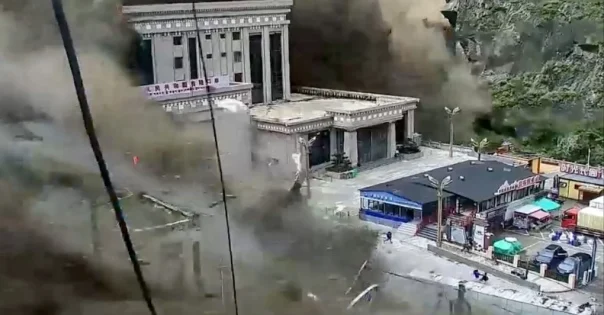
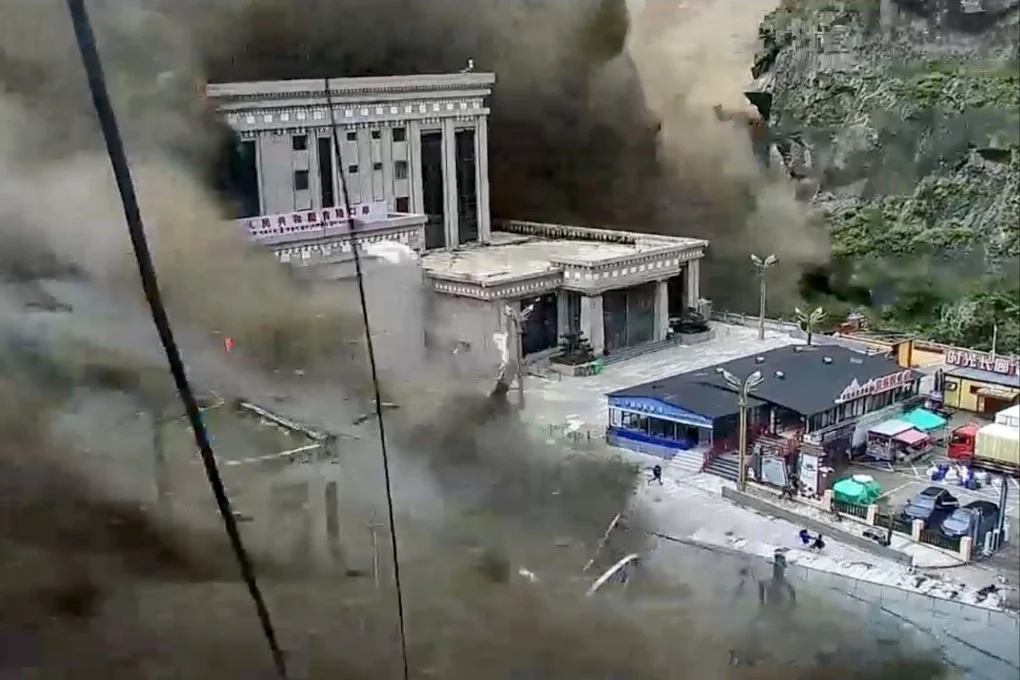
The Miteri Bridge at Rasuwagadhi, the steel link between Nepal and the Chinese border town of Gyirong, reopened to trade on 1 January 2026. A Bailey bridge had been erected across the Lhende Khola after a flood destroyed the original crossing, and Chinese authorities confirmed the checkpoint would formally reopen at the start of the year. Traders who had waited almost six months to retrieve stranded containers finally moved them. The customs yard at Timure filled again. Fewer than eight months later, on the morning of 26 August 2026, the crossing, the customs office, the immigration post and the vehicles queued behind them were gone.
That eight-month interval is the most instructive number in the entire disaster. It is the interval between a warning and its dismissal.
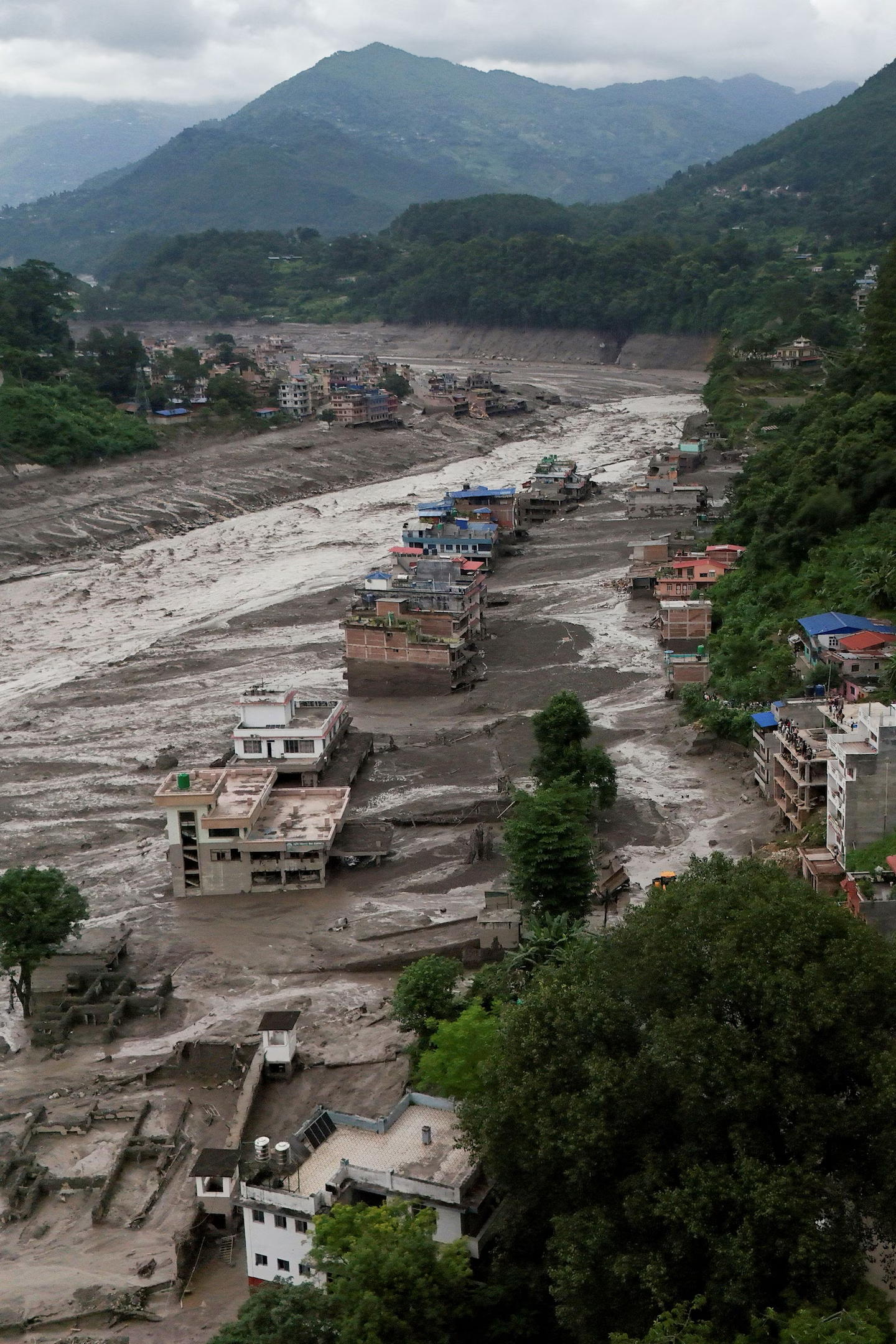
Nepal has since produced a figure for what the second flood will cost. A Rapid Damage and Needs Assessment prepared by a joint technical team led by the National Planning Commission and the National Disaster Risk Reduction and Management Authority puts recovery needs at Rs723.31 billion, of which infrastructure accounts for Rs473.57 billion, or 75 percent. Set that against the national accounts. The budget for the current fiscal year 2083/84 totals Rs2,124.34 billion, of which capital expenditure is Rs431.1 billion. The recovery bill is roughly a third of the entire federal budget and more than one and a half times everything Nepal plans to spend on capital formation this year. This is not a line item. It is a structural fiscal event.
A hazard chain, not a flood
The word “flood” flatters the event by making it sound familiar. What happened on 26 August was a sequence.
Satellite imagery reviewed after the disaster showed that a section of glacier and bedrock roughly 600 metres across collapsed from about 5,200 metres and fell some 1,200 metres into the valley below. Mohd. Farooq Azam, a cryosphere specialist at the International Centre for Integrated Mountain Development, estimated the collapsed mass at 100 to 200 million cubic metres. Friction melted ice as the mass travelled, which entrained soil and rock, and the debris then dammed the Lhende Khola; water accumulated behind the temporary barrier until it failed, releasing the surge that destroyed settlements downstream.
Two corrections to the prevailing account matter for policy. First, this was not a glacial lake outburst flood, whatever the early reporting suggested. The July 2025 event on the same river was attributed by the Department of Hydrology and Meteorology and ICIMOD to a supraglacial lake outburst in Tibet; the August 2026 event began with a bedrock failure. The distinction is not academic. A country that monitors glacial lakes and believes it has therefore monitored the hazard has misread its own exposure.
Second, the geography of blame is less convenient than the headlines. Binod Parajuli, a senior divisional hydrologist at the department’s Flood Forecasting Division, said the avalanche originated in Nepali territory and crossed into China as it descended, causing damage on both sides. Gyirong Port on the Chinese side was engulfed. This is a shared hazard in a shared valley, which is both the diplomatic difficulty and the diplomatic opportunity.
What followed is a case study in institutional latency. The collapse occurred at 8:37 am. By 8:50 the gauge at the Syabrubesi hydrological station had been swept away; it had been designed to register gradual rises, not a high-speed debris flow. The District Administration Office informed the Department of Hydrology and Meteorology at around nine. Text alerts reached people in Rasuwa, Nuwakot, Dhading and Chitwan at 9:15, thirty-eight minutes after the avalanche. The National Earthquake Monitoring and Research Centre had in fact recorded seismic activity, but its chief, Lok Vijay Adhikari, explained that the frequency did not match an earthquake, which is the department’s monitoring mandate, so no public alert was issued.
A signal existed. An institution received it. No mandate covered it. Anil Pokhrel, the former chief executive of the NDRRMA, put the general problem bluntly: “There is no such thing as an early warning system in Nepal.” Sensors are not a system. A system requires that an anomaly detected by one agency automatically obliges another to act.
One corridor, many functions
The reason a single valley could generate a national fiscal emergency is that Nepal had loaded almost everything into it.
The Bhote Koshi and Trishuli corridor carried, simultaneously, Nepal’s busiest overland gateway to China, a dense cascade of hydropower projects, the transmission infrastructure connecting them, the road to the Langtang trekking region, the staging route for pilgrims travelling to Kailash and Mansarovar, and settlements rebuilt after the 2015 earthquake. Each of these was appraised as a discrete project. None was appraised as a component of a system whose parts fail together.
Consider trade. After the 2015 Gorkha earthquake effectively closed the older Tatopani route, Rasuwagadhi became the principal northern gateway; by 2024 the Gyirong crossing was handling around US$604 million in trade, close to a third of all Nepal-China commerce. In the six months following the July 2025 flood, trade through Rasuwagadhi fell by 95 percent, from US$302 million to US$15 million, according to an analysis of Nepal’s own customs accounts by the Stimson Center. The Chief Customs Officer at the time put the revenue loss from the six-month closure at around Rs20 billion against the comparable period a year earlier. Traffic rerouted. Korala in Mustang recorded Rs11.01 billion in trade within roughly three months of full operation. Substitution was possible, in other words, but only slowly and at a cost that nobody had budgeted for in advance.
Consider energy. The August flood affected thirteen hydropower projects with a combined capacity of 759 megawatts and five solar plants totalling 24 megawatts, with restoration of energy and grid systems alone estimated at Rs390.62 billion. The Nepal Electricity Authority reported that roughly 430 megawatts of generation, transmission and distribution capacity was damaged across six named plants. In the fiscal year ending in mid-July 2026, Nepal had become a net electricity exporter for the first time in nearly a decade of trade with India, earning Rs18.75 billion from sales to India and Bangladesh. Exports fell from around 1,000 megawatts during the wet season to roughly 650, and supplies to Bangladesh stopped altogether after the 22.1 MW Chilime and 24 MW Trishuli plants were damaged. A single morning reversed a decade-long trajectory in Nepal’s most strategically significant export sector.
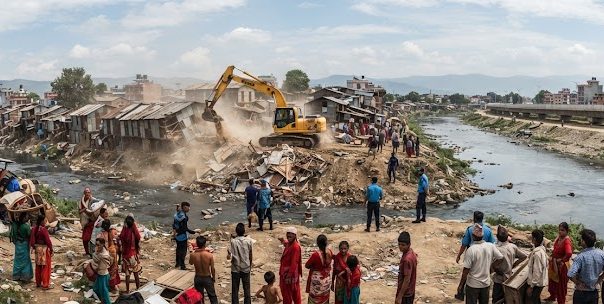
Consider settlement. Families displaced by the 2015 earthquake had been resettled on the low banks of the Trishuli; one such community of 250 households was swept away in its entirety. Recovery from one disaster created the exposure for the next. That is the cascade in its purest and most damning form.
Assessment is not prioritisation
Nepal’s disaster machinery works reasonably well at counting. The RDNA was produced within a fortnight, sector by sector. NDRRMA chief executive Dharmaraj Uprety described it as a preliminary estimate compiled from the Department of Roads, the Central Bureau of Statistics and the ministries of agriculture and energy, using drone surveys and pre- and post-flood comparison, with a fuller Post-Disaster Needs Assessment involving the World Bank to follow. By any regional standard this is competent.
| Sector | Estimated recovery need (Rs bn) |
| Energy and grid systems | 390.62 |
| Housing, public buildings and services | 103.54 |
| Disaster risk reduction and river management | 94.75 |
| Transport (roads and bridges) | 73.34 |
| Productive sector (trade, banking, agriculture) | 50.77 |
| Debris and mud clearance | 0.52 |
| Total | 723.31 |
Source: Rapid Damage and Needs Assessment reporting, Infrastructure categories together account for Rs473.57 billion.
The weakness lies downstream of the count. The government divided reconstruction into two phases: Rs8.73 billion for immediate relief and short-term work over six months, and Rs714.58 billion for long-term reconstruction. That ratio, roughly one to eighty, is the shape of every Nepali recovery since 2015: a small, fast, politically visible tranche, followed by an enormous obligation with no financing plan attached and no institutional vehicle yet designated to deliver it.
Damage assessment answers what was lost. It does not answer what should be rebuilt, where, to what standard, or whether it should be rebuilt at all. That is a planning question, and in Nepal it is currently being asked after the assessment rather than before the investment. The National Planning Commission has begun work on a master plan covering safer settlements and longer-term development needs, and the government is identifying relocation sites, with around fifteen settlements destroyed across Rasuwa, Nuwakot and Dhading. Necessary work, begun in the wrong order.
The strongest case against this argument
A serious critic would make two objections, and both deserve a straight answer.
The first is that this event was genuinely unforecastable. Jeff Da Costa of the University of Reading cautioned that while warming is altering glaciers, permafrost and slope stability across the Himalaya, the individual collapse could not be attributed to climate change without further analysis. NDRRMA officials noted that the terrain above Timure is extremely remote, that real-time monitoring there has proved very difficult, and that the slope in question sat in a blind spot that neither Nepal, China nor international geologists were watching. A departmental information officer observed that with 20 to 25 percent of Nepal classified as mountain, monitoring everything is impossible on available resources. All of this is true. Nepal is a low-income, landlocked state with a narrow revenue base and a single realistic northern corridor. Concentrating investment there was a rational response to constraint, not negligence.
The objection holds for the hazard. It does not hold for the loss. An unpredictable trigger explains why the mass moved; it does not explain why a dry port sat on a floodplain that had flooded thirteen months earlier, why earthquake survivors were resettled on a low riverbank, or why the replacement bridge was reinstated on essentially the same alignment within months of the first destruction. Ashish Gajurel, who chairs the House of Representatives’ Development Committee and formerly led the Nepal Intermodal Transport Development Board, made the point himself: the 2025 flood had already issued a clear warning about the customs point and the settlements around it, and it was not taken seriously enough. The July 2025 event was a free experiment in corridor failure. Nepal ran it, recorded the results, and priced them at zero.
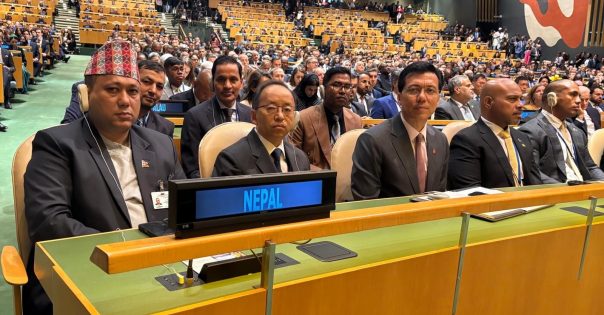
The second objection is more sophisticated and comes from within Nepal’s own foreign policy. It holds that the binding constraint is external finance, not domestic planning, and that the correct response is to press the case for climate justice. Foreign Secretary Amrit Bahadur Rai told the House International Relations and Tourism Committee that Nepal would use the eighty-first UN General Assembly to seek climate finance and compensation for loss and damage, including through the Fund for Responding to Loss and Damage, and would host a high-level side event on the Himalaya.
The case is morally sound and diplomatically correct. It is also arithmetically insufficient, and Nepali policymakers should say so plainly rather than discover it later. The Fund’s start-up phase, the Barbados Implementation Modalities, set aside a total of US$250 million for the calendar years 2025 and 2026, with individual allocations of US$5 to US$20 million. Nepal’s contingent credit line with the World Bank, the Disaster Resilience Development Policy Credit with a Catastrophe Deferred Drawdown Option signed in October 2024, is worth US$150 million. Finance Minister Swarnim Wagle told Reuters that rebuilding could cost US$4 to US$5 billion, an estimate the RDNA has since broadly confirmed at US$4.74 billion. Even a maximally generous international response covers a small fraction of the bill. Climate finance is a supplement to domestic risk management. It cannot be a substitute for it.
The vulnerability Nepal has already been assessed on
There is a quieter irony running underneath all of this, and it sits squarely in the Ministry of Foreign Affairs’ in-tray.
Nepal is scheduled to graduate from the Least Developed Country category on 24 November 2026, and on 13 May 2026 the government wrote to the chair of the UN Committee for Development Policy seeking postponement, citing geopolitical tensions, supply-chain disruption, slow implementation of its Smooth Transition Strategy, and risks to exports and employment. Nepal qualified for graduation on the human assets and economic and environmental vulnerability criteria, which is to say it was formally assessed as sufficiently un-vulnerable to exit. Three months after that letter, a single morning in Rasuwa generated a recovery requirement equal to a third of the national budget. One research organisation has already argued that the current framework does not adequately assess whether natural, physical and institutional capital is being maintained, and has called for a post-disaster review.
Whatever one thinks of deferral, the episode exposes something real: the international metrics by which a mountain state’s vulnerability is judged do not capture the concentration risk that defines it. A country can score well on averages while running a portfolio in which one valley carries the trade gateway, a tenth of the power supply and the principal tourism route. That is a case Nepal is better placed than almost anyone to make, and it is a more durable argument than compensation.
What would actually change the sequence
None of the obvious recommendations are novel. What is missing is the ordering.
Make hazard mapping a precondition of approval, not an annexe to it. Swiss cantons are obliged by federal law to produce hazard maps and to reflect that risk in land management; the maps determine where building is permitted and under what conditions. Nepal cannot replicate Swiss coverage on a Swiss budget. It can, however, require that no federally funded infrastructure above a threshold value receives approval without a multi-hazard assessment covering process chains, not single hazards, and that the assessment be published.
Appraise the basin, not the project. A cascade of hydropower schemes in one gorge is a portfolio with near-perfect correlation of failure. The financiers of these projects, which include multilateral and bilateral institutions, apply safeguards that treat each scheme as a unit. A basin-level cumulative risk requirement, agreed between the Investment Board, the Department of Electricity Development and the lenders, would price what project-level appraisal cannot see.
Treat corridor redundancy as a fiscal objective with a number attached. Nepal already learned in 2025 that Korala can absorb diverted traffic. The question is whether redundancy is maintained deliberately, with the standing cost of a second functioning northern gateway recognised as insurance, or improvised each time the primary corridor fails.
Negotiate the transboundary protocol as an instrument, not a paragraph. An NDRRMA geologist described the existing arrangement candidly: there is no protocol, and information involving another country is routed through the Ministry of Foreign Affairs. Anil Pokhrel warned that without a mandatory protocol, alerting depends on the subjective judgement of whoever holds authority at the time. Nepal and China both lost infrastructure and lives in this valley. Beijing has responded positively to Nepal’s request for assistance in rebuilding the Syaphrubesi–Rasuwagadhi road, though no formal agreement has been signed. A binding hydrological and seismic data-sharing agreement, with defined triggers, named counterparts and automatic transmission, is a concrete deliverable that the reconstruction conversation could carry.
Publish the contingent liability. Nepal’s budget documents disclose debt. They do not disclose the state’s expected annual obligation from disaster, or the concentration of that obligation in specific corridors. Once that number is visible to the Ministry of Finance and to Parliament, a layered financing strategy of reserves, contingent credit, sovereign risk transfer and only then international appeal becomes a budgetary discipline rather than an aspiration.
The third bridge
The Miteri Bridge will be rebuilt. Trade through Rasuwagadhi is too valuable to Nepal, and to Tibet, for it not to be. The question that should occupy the National Planning Commission, the Ministry of Finance and the ministry that will negotiate the Chinese assistance package is not whether to rebuild but whether the third bridge will be the product of a decision or of a reflex.
Nepal has spent a decade treating climate and disaster risk as an emergency-management function: a directorate, an authority, a relief fund, a situation report. The Bhote Koshi floods make the case that this classification is now the vulnerability. When one hazard chain can remove a third of the national budget in an hour, reverse a decade of energy-export progress and sever the principal northern trade corridor for the second time in thirteen months, disaster risk has stopped being a humanitarian variable and become a macroeconomic one.
The useful test is not whether Nepal can rebuild what the flood took. It is whether, the next time an appraisal document crosses a desk in Singha Durbar, anyone is required to ask what else fails when this one does.
Sources consulted
- Ministry of Foreign Affairs, Government of Nepal. Daily Situation Updates on the Bhote Koshi River Floods, 6–10 September 2026. https://mofa.gov.np/content/1883/daily-update-10-september-2026/
- National Disaster Risk Reduction and Management Authority. Rasuwa–Bhotekoshi Flood Situation Report, 1 September 2026. https://ndrrma.gov.np/mediafiles/rasuwa/Rasuwa_Flood_SitRep_Temp_ENG_01_01092026.pdf
- The Kathmandu Post. Rapid assessment puts Bhotekoshi recovery needs at Rs723 billion, 10 September 2026. https://kathmandupost.com/national/2026/09/10/rs723-billion-needed-to-rebuild-flood-hit-areas-government-assessment-finds
- The Kathmandu Post. What triggered the Rasuwa flood? Scientists piece together a complex chain of events, 28 August 2026. https://kathmandupost.com/national/2026/08/28/what-triggered-the-rasuwa-flood-scientists-piece-together-a-complex-chain-of-events
- The Kathmandu Post. Nepal sent its disaster alert 38 minutes after the glacier collapse, 2 September 2026. https://kathmandupost.com/national/2026/09/02/nepal-sent-its-disaster-alert-38-minutes-after-the-glacier-collapse-it-wasn-t-enough
- The Kathmandu Post. Bhotekoshi floods halt Nepal’s electricity exports to Bangladesh, 2 September 2026. https://kathmandupost.com/money/2026/09/02/bhotekoshi-floods-halt-nepal-s-electricity-exports-to-bangladesh
- The Kathmandu Post. Beijing signals support for rebuilding flood-ravaged Rasuwagadhi route, 14 September 2026. https://kathmandupost.com/money/2026/09/14/beijing-signals-support-for-rebuilding-flood-ravaged-rasuwagadhi-route
- The Kathmandu Post. Foreign secretary says Nepal will press climate justice case at UN, 17 September 2026. https://kathmandupost.com/national/2026/09/17/foreign-secretary-says-nepal-will-press-climate-justice-case-at-un
- The Kathmandu Post. Nepal moves to defer LDC graduation, 22 May 2026. https://kathmandupost.com/money/2026/05/22/nepal-moves-to-defer-ldc-graduation-until-2029
- The Diplomat (reporting Stimson Center analysis of Nepali customs data). The Lasting Economic Damage From the China–Nepal Flood, September 2026. https://thediplomat.com/2026/09/the-lasting-economic-damage-from-the-china-nepal-flood/
- OnlineKhabar English. Rasuwa customs point’s future uncertain after floods wipe out key infrastructure, September 2026. https://english.onlinekhabar.com/rasuwa-customs-points-future.html
- Trade via Rasuwagadhi border resumes after six-month closure, 28 December 2025. https://myrepublica.nagariknetwork.com/news/trade-via-rasuwagadhi-border-resumes-after-six-month-closure-30-32.html
- Eco-Business. Flood disaster tests Nepal’s hydropower ambitions and exports, September 2026. https://www.eco-business.com/news/flood-disaster-tests-nepals-hydropower-ambitions-and-exports/
- Fund for Responding to Loss and Damage. Barbados Implementation Modalities, decision B.5/D.4, 2025–26. https://www.frld.org/nodebim
- World Bank. Partnership to strengthen Nepal’s disaster response and resilience (Cat DDO, US$150 million), 29 October 2024. https://www.worldbank.org/en/news/press-release/2024/10/29/world-bank-approves-150-million-to-strengthen-nepal-s-disaster-response-and-resilience
- Ministry of Finance, Government of Nepal. Budget Statement for the Financial Year 2083/84, 29 May 2026. https://mof.gov.np/content/1741/budget-statement-for-the-financial-year-2083-84/
- Glacial lake inventory and Hindu Kush Himalaya cryosphere assessments, 2025–26. https://www.icimod.org/
- Federal Office for the Environment (FOEN), Switzerland. Natural Hazards: Maps, 2026. https://www.bafu.admin.ch/en/natural-hazards-maps